
Joining the Conversation
Eric Seiffert
Director of Marketing
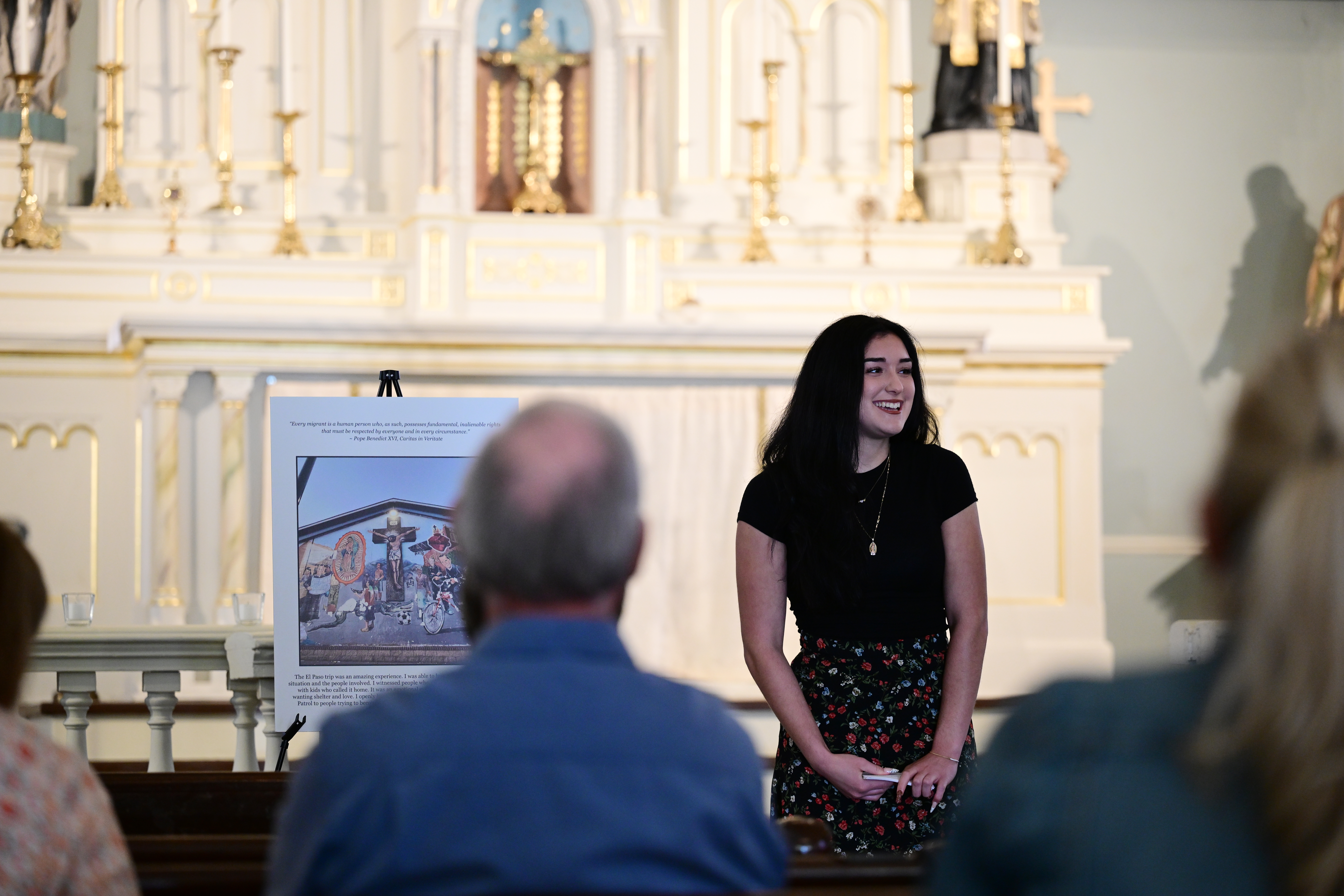
Duchesne senior Isabel Rakers presented an in-depth look at immigration law and the plight of undocumented migrants in the United States on March 21 at the St. Ferdinand Shrine in Florissant, Missouri. The presentation served as the culmination of her Scholars Academy Capstone Project.
Her talk focused on debunking common misconceptions, such as the notion that all migrants are a drain on the national economy, while highlighting personal testimonies about the dangers of traveling to the border.
“Stories like this reflect a much bigger reality,” Rakers explained. “Many people from Guatemala, Honduras, and El Salvador ... leave home because it is not a matter of choice, but one of necessity.”
The project evolved significantly throughout the fall. Rakers originally planned a workshop on naturalization, but her direction shifted after connecting with Sister Cathy Doherty, SSND, who worked with the Immigration Task Force through the Archdiocese of St. Louis.
“I could hear the passion in her voice,” Sister Doherty said. “I wanted to help her broaden her perspective and explore the realities beyond what the media often portrays. My hope was to share with her ‘the people’—their fears, their reasons for choosing America, and the hopes they hold for their children.”
As part of her research, Rakers traveled to Nuevo Progreso, a Mexican border town. She described it as a community of stark contrasts, marked by a high police presence and normalized homelessness. “It was a very eye-opening experience,” she said.
This firsthand perspective was balanced by an interview Rakers conducted with a Border Patrol agent, who described the “delicate line” agents walk between law enforcement and humanitarian care.
“They see the desperation, the trauma, the courage, and the fear up close,” Rakers noted. She learned that agents often face overwhelming situations, such as days when thousands of arrivals strain the system. Her research highlighted agents administering medical care for dehydration before processing individuals for detention, as well as caring for children who were separated from their families—not by the U.S. government, but by the smugglers who brought them in.
Renee Moore, who teaches the capstone class, praised the depth of the research. “We are extremely proud of Isabel,” Moore said. “She was able to take a very sensitive topic and create an informative talk that presented both sides of the issue effectively.”
Attendees to the talk were offered an opportunity to donate to local organizations dedicated to helping immigrants. As of March 26, Rakers has raised $400.
Rakers concluded her presentation by urging her audience to remember the human element of the immigration debate.
“The question is not simply how we manage our borders, but how we choose to treat human beings who stand at them,” she said. “My hope is that we choose compassion, wisdom, and humanity as we move forward.”